Texas Flood | TAB (F#)
Stevie tunes down a semitone and thinks in the key of G when playing Texas Flood. The main advantage is looser strings, making bends easier.
However, Stevie isn’t aiming for ease—he uses heavy strings to achieve a richer tone, making the bends even more demanding.
For this lesson, I’ve stayed in standard tuning and think in F#, as most players won’t have a guitar tuned down a semitone.
Let’s get started—this is extremely challenging, but stick with it. The goal is clear from the outset: do not memorise this TAB.
Intro
Here’s a note-for-note transcription in the key of F#. Strictly speaking, it can’t be exact, as Stevie is thinking in G. I’ve also moved some licks from strings 1 and 2 to strings 3 and 4 i a different shape for practicality.
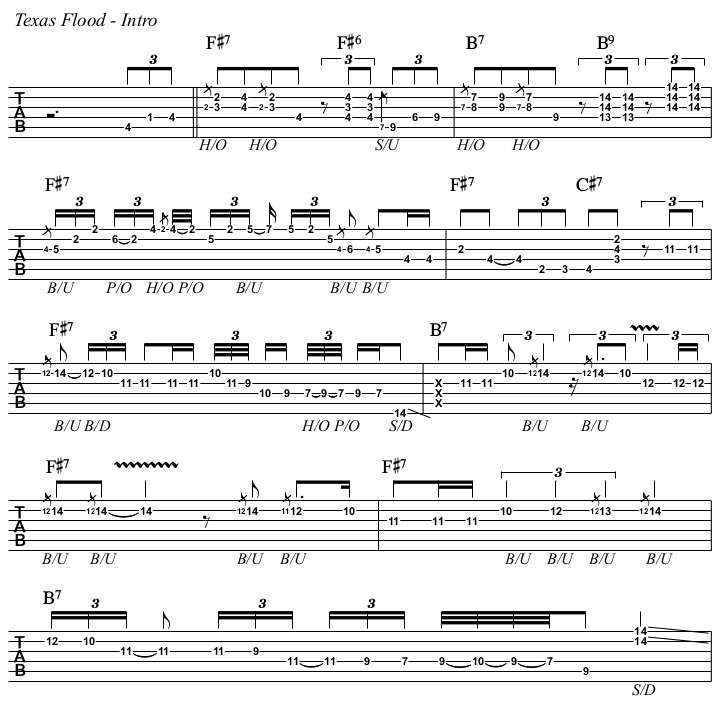
There’s so much happening here that I had to stop transcribing before the intro even finished.
Stevie doesn’t memorise licks and repeat them—he develops ideas in a stream-of-consciousness way. If we want to play like him, we must do the same rather than copy.
Let’s begin with the opening lick—the signature phrase and the only part played consistently. Before we develop it, we copy it.
Lick 1
Here are the first couple of bars, starting from an E shape. Musically, this is outstanding—stay with it until it feels identical to the original recording.
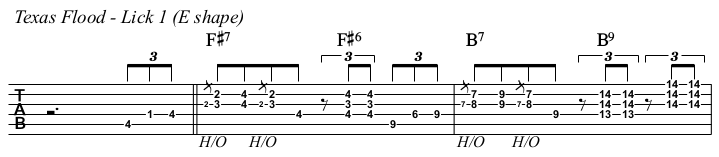
Let’s break it down:
- The opening notes outline F# major pentatonic
- A hammer-on moves from the minor 3rd to the major 3rd, with the 5th above
- This is followed by a quick B/F# (or F#6sus4), before repeating the idea
- We then move to F#6 before building into the IV chord
- The B7 mirrors the F#7 in the same E shape
- We finish on a B9 in a C shape
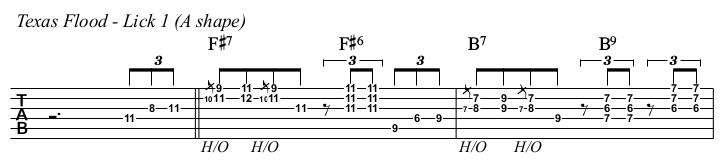
Once secure, move the idea to an A shape:
We shift the first idea up an octave while keeping the second the same, creating a descending feel. The 9 chord is now played as an E shape—similar to what Prince uses in Kiss.
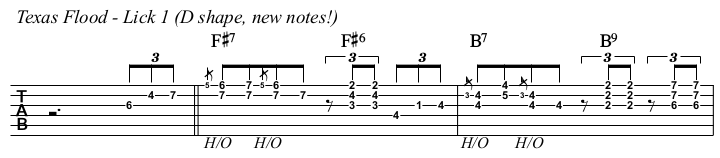
Now try it in a D shape:
Here, the chord lick changes slightly. Instead of moving from the minor to major 3rd over a 5th, we play it over the root. The IV chord is also down an octave.
Lick 2
This lick is just one beat long. Stevie takes a classic F# minor pentatonic idea—three notes often repeated by players like T-Bone Walker and Chuck Berry—and transforms it.
Instead of repeating the phrase, he moves from b7 to 5th and then adds a surprising 9th. You can think of this as blending minor and major pentatonic, or simply adding colour with the 9th.
After playing the opening lick, leave a beat of space, then move it:
- First to a Dm shape, introducing new notes and finishing on the 9th
- Then to a Cm shape, with a stretch and a subtle bend on the minor 3rd
- Finally, a variation that feels similar but moves towards the 5th instead
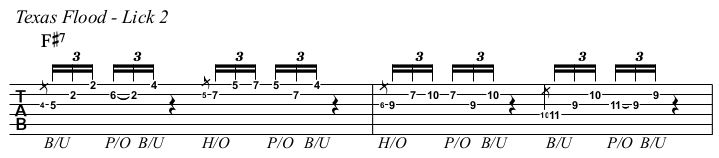
The detail here is crucial—this is exactly how Stevie plays, constantly shaping notes with bends, hammer-ons, and pull-offs.
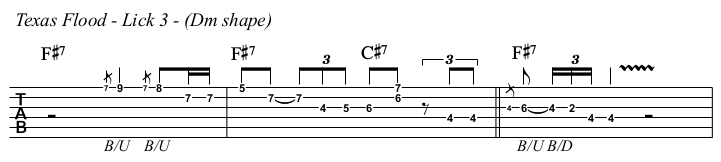
Lick 3
Now let’s look at a longer phrase from the turnaround:
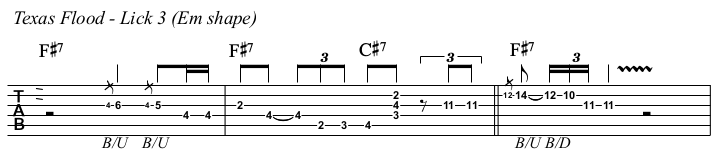
The opening bend moves from fret 4 to 6, then settles on 5, outlining intervals of 4th, 5th, and b5th. It’s a difficult sound to control, but incredibly effective when done well.
We then descend through minor pentatonic, add a chromatic line into the V chord, and set up the next chorus by shifting position up the neck.
Move this idea up an octave into an Am shape (keeping the final lick the same).
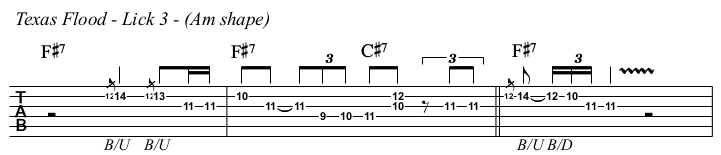
Then into a Dm shape, transposing the ending:
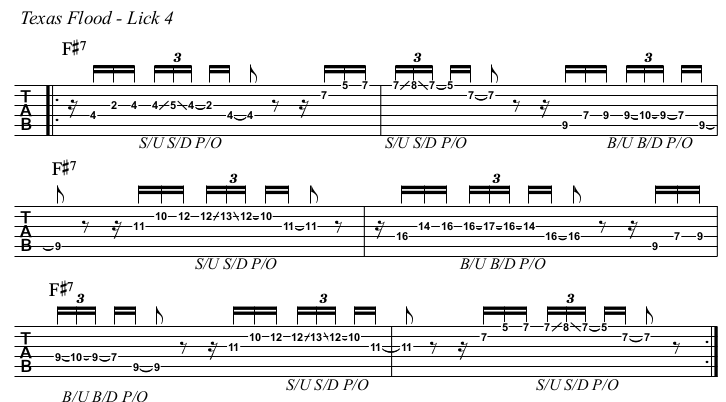
Lick 4
When transcribing blues, aim to get as close as possible—but when you hit a wall, follow the rabbit hole.
This lick came directly from that process. As soon as it clicked, I wrote it down and explored it across the neck—sometimes sliding, sometimes bending.
Lick 5
For this lick, I took an idea from the final bar of the intro transcription, moved it forward by a beat, repeated it in a new position, and varied the phrasing with slides and bends.

Stevie plays in a stream-of-consciousness way, and we should aim to do the same. Use these ideas, move between them, and play along with the original recording—ideally removing the guitar so you can lock in with the band while Stevie sings.
Then return to transcription, refine it, and follow the next rabbit hole.
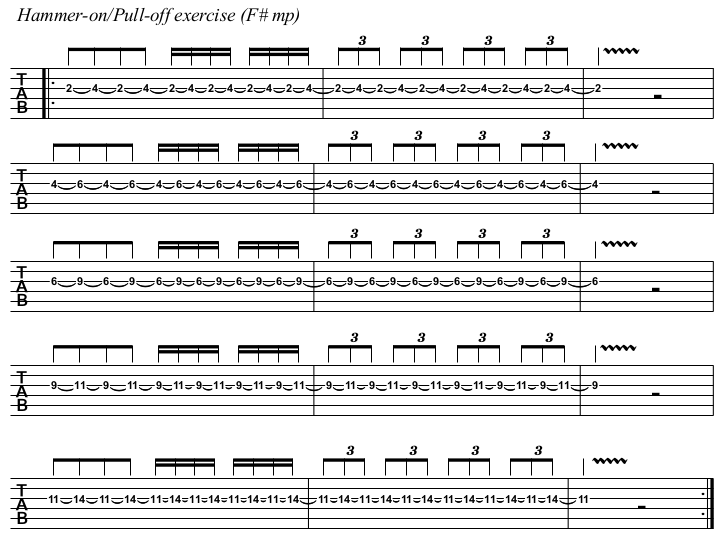
If you struggle with a technique—such as hammer-ons and pull-offs—turn it into an exercise. For example:
On a single string, practise hammer-ons and pull-offs using different rhythms as you move up the minor pentatonic scale.
When you feel brave enough, jam along with the various backing tracks, one of them is in the key of G!
Texas Flood Backing Tracks + TAB | Related Pages
Texas Flood | Chords + Lyrics
You can learn how to play Texas Flood by Stevie Ray Vaughan using chords, lyrics, chord analysis, a chord chart, and the original recording.
| G7 | C7 | G7 | G7 |
Well, it’s floodin’ down in Texas, all of the telephone lines are down…
Five similar tunes | Chords + Lyrics

- Ain’t No Sunshine
- Born Under A Bad Sign
- Call It Stormy Monday
- Still Got The Blues
- The Thrill Is Gone