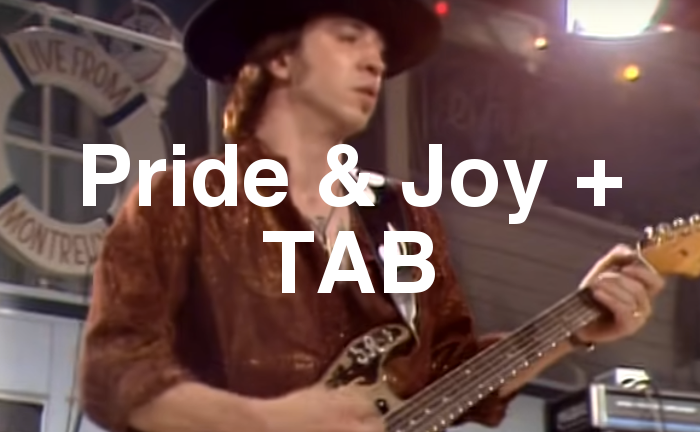
Pride & Joy | TAB (tune down 1/2 step – or use backing track in the Key of E)
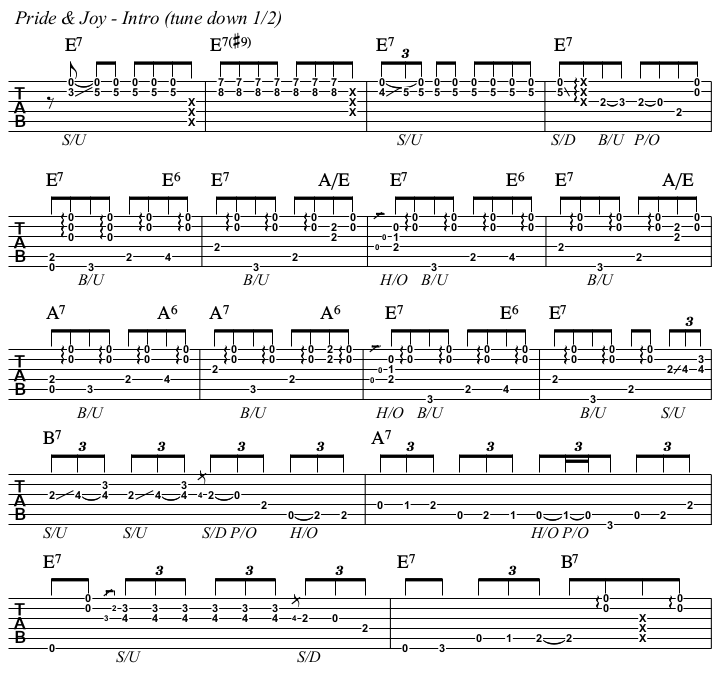
Tune down to Eb if you’re playing along with the original. Then, bar by bar, start learning from the TAB—expect this to take many hours.
Intro
The famous intro is played as if all 8th notes are broken triplets. Start very slowly, gradually building up speed. The feel of the shuffle rhythm matters most—make sure it bounces against the bass line. Most of these notes should be played short.
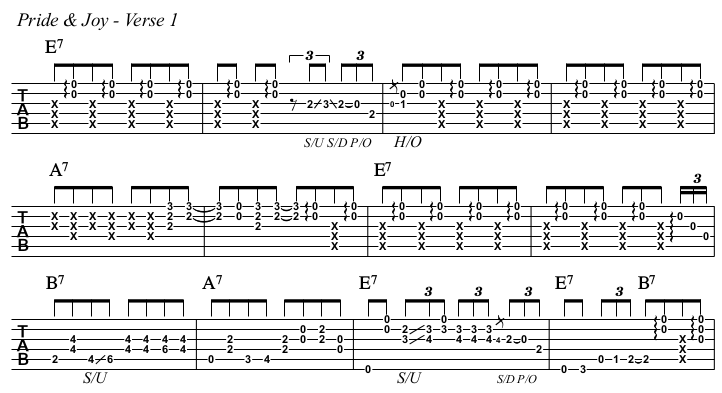
Verse
The verse relaxes slightly as we play the shuffle rhythm with scratches and open top strings. These are still played short—this is where the bounce comes from. As we reach chord V, a honky-tonk figure is introduced, hitting the 6th over B, but not over A.
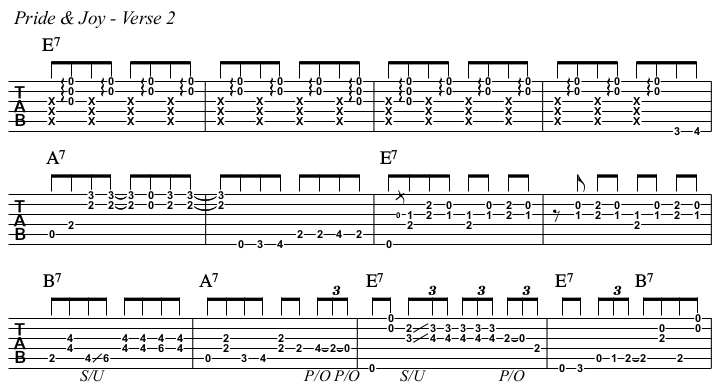
In the second verse, we follow a similar approach, though with some variation—make sure you nail this.
In bar 6, I feel as if SRV has gone back to E early! The E chord in bars 7 and 8 now features the same honky-tonk 6th we used over chord V, but this time as part of the chord rather than a bass line figure. You could describe this as A/E.
The A7 in bar 10 also briefly includes a 6th, but it’s extremely quick.
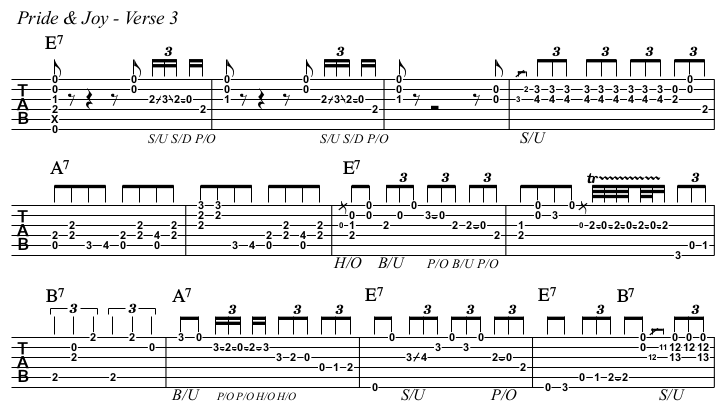
The third verse begins with stops. There are two particularly challenging licks here: the trill in bar 8, and the fast pull-offs and hammer-ons in bar 10. These will take time to master. Ultimately, it’s better to think of them as concepts rather than fixed licks.
Consider how you can move these ideas to other areas of the neck, targeting different notes from the minor blues scale, rather than relying on open strings.
Solo
The solo begins with triplets, moving between different parts of an E7 shape. After three bars, we shift between an Em-shaped blues scale at the 12th fret and the open position.
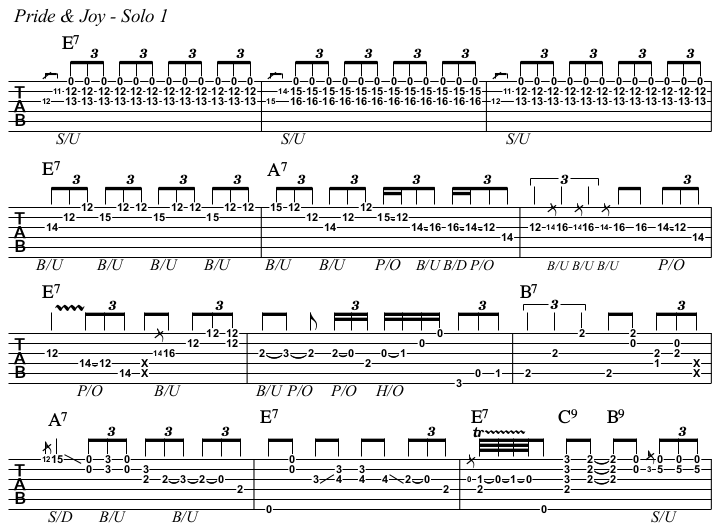
If you’ve made it this far, you’ve probably realised that Stevie is improvising—meaning that next time, he won’t play these notes in exactly the same way.
The ideas and note choices remain, but they appear as a stream of consciousness rather than something memorised.
To truly play like this, you need to reach that same state—not just reproduce this exact solo.
The only way to get there is to memorise the TAB, then let it go and play freely. It takes time—some players spend a lifetime developing this.
This doesn’t mean you should stop learning TAB. It simply means you must learn it, then let go, to discover whether it’s truly been absorbed.
Pride & Joy Backing Tracks + TAB | Related Pages
Pride & Joy | Chords + Lyrics
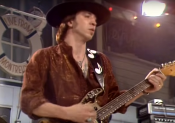
You can learn how to play Pride & Joy by Stevie Ray Vaughan using chords, lyrics, chord analysis, a chord chart, and the original recording.
| E7 | E7 | E7 | E7 |
Well, you’ve heard about love givin’ sight to the blind…
Five similar tunes | Chords + Lyrics