Money (That’s What I Want) TAB | Minor Pentatonic + Blues Language
Before we dive into all the different ways you can play the riff and the rest of the song, we need to address something important: understanding blues melodic language. And to do that, we turn to the king of scales – the minor pentatonic.
Why the Minor Pentatonic?
Blues language stems from the use of dominant 7th chord extensions within a I – IV – V progression.
In most songs, the chords are all diatonic — they share the same notes from the major scale. Take Redemption Song as an example: it uses chords I, VI, IV, II, and V — all of which come from the same key. No chord steps outside that framework.
But in a 12-bar blues using dominant 7th chords, that’s not the case.
Let’s look at an example:
- The I chord, F7, contains the major 3rd: A
- The IV chord, Bb7, contains a b7: Ab
If you changed F7 (F – A – C – Eb) to Fm7 (F – Ab – C – Eb), you’ll notice how these two chords introduce conflicting tones — A vs Ab.
So, what do you do? Use the A or the Ab?
The answer is both.
And using both is your first real step into the blues language.
The “Blue” Notes
The next classic blues tone is the b5 — the so-called “blue note”. Adding this note gives us the Minor Blues Scale.
You’ll learn the full scale later, but for now, focus on finding the b5 and the relationship between:
- 4 → b5
- b5 → 5
This movement is part of the signature blues sound.
Your Mission for This Step
Learn three minor pentatonic shapes and locate:
- The minor 3rd (m3rd)
- The flat 5th (b5)
You’ll discover these by learning the vocal melody of Money (That’s What I Want).
Exercise 1 – Em Shape
Here’s the TAB for the first example:
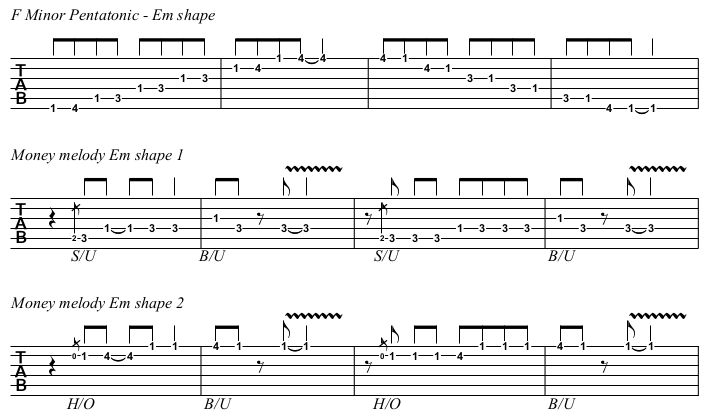
As you’ll see, the melody slides or hammers into the 5th from the b5.
The m3rd is bent slightly towards the major 3rd — both intervals appear in the riff, which is why it works so well.
Here’s a loop to practise along with. Use this or the individual TAB loops in the playlist above:
Exercise 2 – Dm Shape
In the Dm shape, the root sits in the middle of the pattern.
Practise playing upwards, then back to the root, then below it.
You’ll find the key intervals again by learning the melody — and don’t forget those signature slides and bends!
Here’s the TAB:

Exercise 3 – Am Shape
Lastly, learn the minor pentatonic in the Am shape.
Here’s the TAB:

🎯 Spend 10–15 minutes on each shape, making sure you can play both the scale and the melody.
A Note on Shapes & Theory
Notice:
- The Em shape = same notes as a G–shape major pentatonic
- The Dm shape = E shape
- The Am shape = C shape
Yes — they contain the same notes.
No — they are not the same scale.
What matters most is how you see the intervals in relation to the root — just as you would when constructing a chord.
Key Takeaway
Blues language is all about how you treat the:
- m3rd
- 3rd
- b5
Manipulating these intervals gives your playing that unmistakable blues character.
If you can recognise these intervals when playing a scale, you’ll know how to use them expressively. If not, you’ll be stuck guessing.
Next time, we’ll look at the remaining two minor pentatonic shapes.
Money (That’s What I Want) Guitar Lesson | Related Pages
Intermediate Electric Course

When playing Motown & Soul tunes, we must know all CAGED barre chords and pentatonic scales to build rhythm parts, incorporate licks and play solos.
Complete the Intermediate Electric Course and you will map out the fretboard, as well as gain an understanding of how to create a guitar part that works in a band.
Money (That’s What I Want) | 8 Step-by-step guitar lessons

As well as learning the very interesting main riff of Money (That’s What I Want), there’s plenty more going on in these lessons.
As well as varying the turnaround, we also have a solo to get our teeth into. This is an important lesson as we can build any solo using this concept.
Money (That’s What I Want) | Chords + Lyrics

Learn how to play Money (That’s What I Want) by Barrett Strong using chords, lyrics, a chord chart, backing track, the original recording, and Spytunes video guitar lessons.
| F N.C | N.C Bb C |
The best things in life are free…
Five similar tunes | Chords + Lyrics