Belief | TAB
Believe it or not, this isn’t as difficult as you may fear. Throughout Belief, John plays a series of loops which, once under your fingers, tend to play themselves.
Let’s start from the top. Keep your eye on all the small details throughout — mainly the slides, hammer-ons, and bends.
Intro + Verse
The main riff is fairly straightforward. I actually found it more difficult to name the chords than to play the riff — so we’ll spend some time on that. First, learn this:
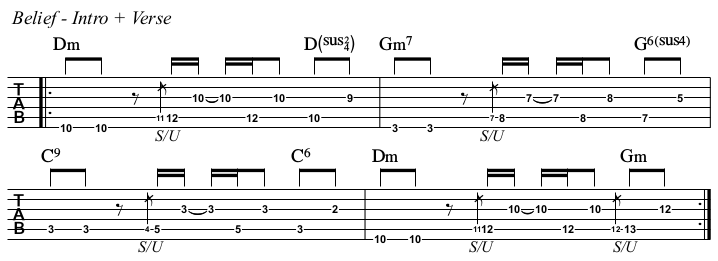
If you’re thinking something doesn’t sound 100% right, you’re correct. There’s a small detail he includes most of the time — but not always. It’s also more difficult to play, so it’s best to begin with the version above.
The missing detail appears on beat 4 in bars 1–3, where he plays two notes, muting the string in between:
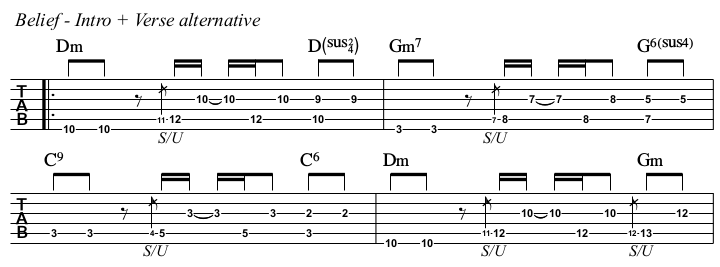
Once you can play both versions with ease, make sure you can see all intervals in relation to each chord:
- Bar 1 – Root, 5th, and m3rd form the full triad. On beat 4, we play the 4th and 9th — no 3rd — so this can be named sus2/4.
- Bar 2 – Root, b7th, and 5th. There’s no 3rd, but if played fully it would be minor, so Gm7. Beat 4 gives us the 6th and 4th — G6sus4.
- Bar 3 – Root, 9th, and b7th. No 3rd, but implied major, so C9. Beat 4 is root and 6th — C6.
- Bar 4 – Root, 5th, and 3rd as in bar 1. Beat 4 gives us b6 and sus4 in relation to D, but as the bass moves to G, this becomes Gm (m3rd to root).
It’s important to understand these intervals and relate them to chord names. This is the best way to remember what to play, especially when working from a chord chart.
Chorus (+ solo chords)
The chorus follows the same concept but uses different chords. Learn it first, then analyse the harmony:
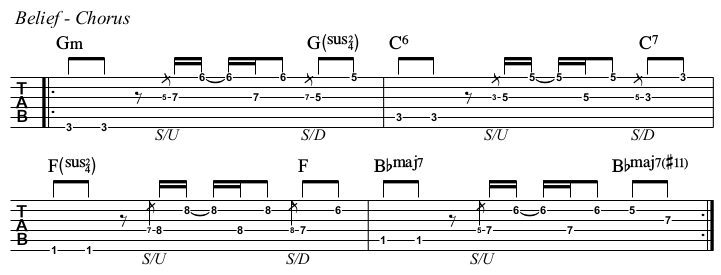
Here’s how the chords are derived:
- Gm – Root, 5th, m3rd. We then move down, similar to Soul Man (though that’s major), creating a classic movement — Gsus2/4 (or C6/G).
- C6 – Root, b7th, and 5th. No 3rd, but implied major — C6. Moving down gives us C7.
- Fsus2/4 – Root, 4th, and 9th, resolving to 3rd and root — F.
- Bbmaj7 – Root, 7th, and 5th. No 3rd, but clearly major — Bbmaj7. The final movement adds #11 and 3rd, making Bbmaj7#11. As chord IV in a Lydian context, this name is particularly useful.
Bridge
The bridge introduces muted picking. Learn it first, then consider the harmony:
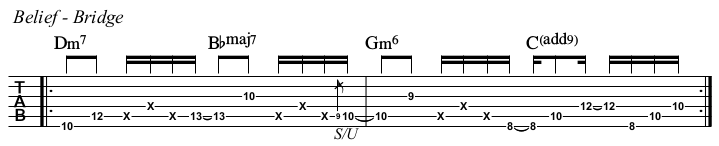
- Dm7 – No 3rd present, but established earlier as minor.
- Bbmaj7 – Only root and 5th here, but context confirms the full chord.
- Gm6 – Root and 6th, with implied minor quality.
- Cadd9 – Root, 5th, and 9th. Technically Csus2, but Cadd9 reflects the fuller harmony more accurately.
Solo
Here’s the excellent solo. Sonically, it leans a bit too much towards what Eric Clapton called “woman tone” (rolled-off highs), but the note choices, phrasing, and rhythm are superb.
Most bends are clearly indicated, showing both the starting note and target pitch. In the final bar, however, the bend is more subtle — not quite a semitone.
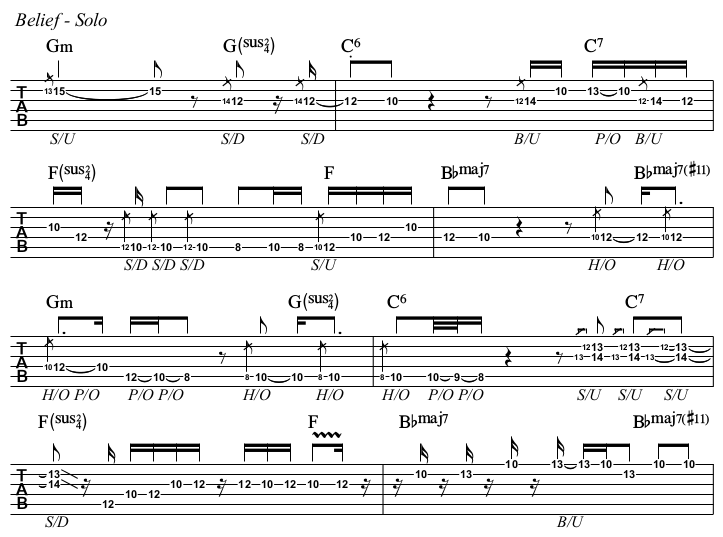
Once you can play all the TAB and understand the chord names, return to the chord lesson. From there, use only the chord chart and backing tracks to bring everything together.
Belief Backing Tracks + TAB | Related Pages
Belief | Chords + Lyrics
You can learn how to play Belief by John Mayer using chords, lyrics, chord analysis, a chord chart, and the original recording.
| Dm Dsus2/4 | Gm7 G6sus4 |
Is there anyone who, ever remembers…
Five similar tunes | Chords + Lyrics